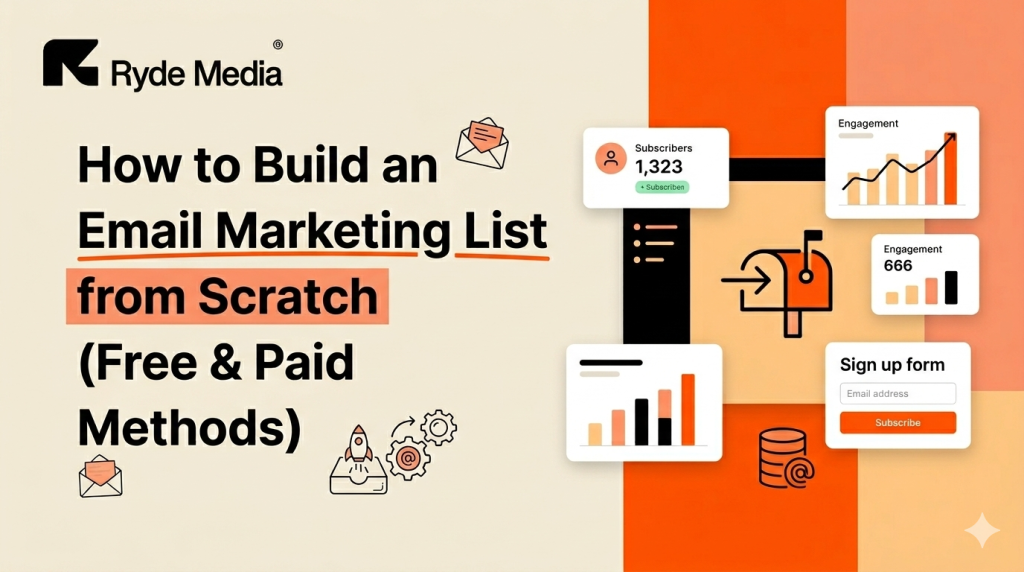
How to Build an Email Marketing List from Scratch (Free & Paid Methods)
You’ve launched your business. Your website looks great. Your products or services solve real problems. But here’s the frustrating reality—nobody’s buying because nobody knows you exist.
Social media feels like shouting into the void. Paid ads drain your budget with questionable returns. You need a marketing channel you actually own, one that doesn’t disappear when an algorithm changes or a platform decides to charge for reach.
That’s where email comes in. Building an email list is like constructing your own marketing infrastructure. Every subscriber is a direct line to a potential customer, someone who’s actively interested in what you offer. No middleman, no algorithm gatekeepers, just you and your audience.
At Ryde Media Inc, we help businesses build marketing systems that actually generate revenue, and email consistently delivers the highest ROI of any digital channel. But here’s what nobody tells you—growing an email list from zero is hard work. It requires strategy, consistency, and a willingness to provide genuine value before asking for anything in return.
So let’s break down exactly how to create an email marketing list that drives real business results, whether you’re working with a shoestring budget or ready to invest in growth.
What Actually Is an Email List in Digital Marketing?
Before we dive into tactics, let’s establish what we’re talking about. An email list is simply a collection of email addresses from people who’ve given you permission to contact them. That permission part matters enormously—legally and ethically.
What is a list in email marketing beyond just email addresses? It’s your most valuable business asset. These are people who’ve raised their hands and said “yes, I want to hear from you.” They’re interested in your industry, your products, or your expertise. That opt-in moment represents trust, and trust converts.
There’s an important distinction to understand here—the difference between list and leads in email marketing. A list is your entire subscriber base. Leads are qualified prospects within that list who’ve shown buying intent through their behaviour. Someone who downloads your free guide is on your list. Someone who downloads your guide, clicks your pricing page, and requests a demo is a lead.
Your email list is also fundamentally different from purchased lists or scraped contact databases. Those aren’t real lists—they’re collections of people who never asked to hear from you. Using them damages your sender reputation, gets you marked as spam, and violates regulations like GDPR. Don’t do it.
According to Litmus research, email marketing delivers $36 for every $1 spent. But that ROI only materialises when you’re emailing people who actually want to receive your messages.
Start with the Foundation: Creating Your Opt-In Offer
Here’s the cold truth—nobody’s giving you their email address just because you asked nicely. You need to offer something valuable in exchange. This is called a lead magnet, and it’s the cornerstone of how to build an email list for free.
Your lead magnet should solve a specific, immediate problem for your target audience. Not a vague promise of value—an actual solution they can implement today.
For B2B businesses, this might be a detailed industry report, a calculator tool, or a comprehensive checklist. A marketing agency could offer “The 10-Point Website Audit Checklist” or “Social Media Calendar Template for Small Businesses.”
For e-commerce, discounts work well. “Get 10% off your first order” is simple and effective. But don’t stop there—exclusive early access to sales, free shipping thresholds, or members-only products also drive sign-ups.
Content creators might offer exclusive content, bonus chapters, resource libraries, or templates. A fitness coach could provide “7-Day Meal Plan” or “Home Workout Video Series.”
The key is matching your lead magnet to where your audience is in their journey. Someone just discovering your industry needs educational content. Someone actively researching solutions wants comparison guides. And someone ready to buy responds to offers and incentives.
Create your lead magnet once, then use it repeatedly to grow your list. This is genuinely how to get email lists for marketing without ongoing investment—your time goes into creating one valuable resource that works for months or years.
Build Your Sign-Up Forms Strategically
Once you’ve got something valuable to offer, you need places for people to actually opt in. This is where list building in email marketing moves from theory to practice.
Website pop-ups get a bad reputation, but they work. The secret is timing and relevance. Don’t blast a pop-up the instant someone lands on your site. Use exit-intent technology that triggers when someone’s about to leave, or time-delayed pop-ups that appear after 30-60 seconds of engagement.
Embedded forms within your content perform excellently. If you’re writing blog posts (which you should be), place sign-up forms mid-content and at the end. Context matters—if your article is about email marketing, your form should offer an email marketing resource.
Landing pages deserve special attention. These dedicated pages with one purpose—collecting email addresses—convert far better than general website forms. Remove navigation, eliminate distractions, focus entirely on communicating value and capturing the email.
Social media profiles provide another avenue. Instagram and TikTok let you add links to your bio. Use these strategically. Create a landing page specifically for social traffic, acknowledging where people came from and tailoring your message accordingly.
Don’t forget offline opportunities. Running a physical event? Collect emails with a simple form or QR code. Speaking at a conference? Offer to send slides or additional resources via email. Every interaction is a potential list-building moment.
The Free Route: How to Build an Email List Without Spending Money
Budget constraints are real, especially for new businesses. Here’s how to build an email list for free using methods that require time and creativity rather than cash.
Content marketing is your most powerful free tool. Publish valuable blog posts, create helpful videos, share insights on social media. Every piece of content should naturally lead people toward your email list. HubSpot research shows that companies that blog consistently generate 67% more leads than those that don’t.
Social media engagement works when done strategically. Don’t just broadcast—actually engage. Answer questions in relevant groups, provide value in comments, build relationships. Your profile should make it easy for interested people to join your email list.
Guest posting gets your expertise in front of new audiences. Write articles for other blogs and publications in your industry. Include a compelling call-to-action in your author bio, directing readers to a relevant lead magnet on your site.
Networking and partnerships cost nothing but time. Connect with complementary businesses and explore co-marketing opportunities. Joint webinars, shared resources, or mutual promotion can expose you to each other’s audiences.
YouTube and podcast appearances offer massive reach without advertising costs. Share your knowledge, provide genuine value, and mention your lead magnet naturally. People who resonate with your message will seek you out.
The challenge with free methods? They’re slow. Building an email list fast through organic methods requires consistent effort over months. But the subscribers you earn this way are highly engaged because they’ve discovered you through valuable content rather than paid promotion.
Accelerate Growth: Paid Strategies That Actually Work
If you’ve got budget available, paid tactics can dramatically speed up how to create an email list for marketing. The key is ensuring your acquisition cost makes economic sense.
Facebook and Instagram ads targeted at lead generation can fill your list quickly. Create a compelling ad showcasing your lead magnet, send people to a dedicated landing page, and watch subscribers flow in. Start with £5-10 daily, test different audiences and creative, and scale what works.
Google Ads for high-intent keywords captures people actively searching for solutions. If someone’s googling “how to improve email deliverability” and you offer a deliverability guide, that’s a perfect match. These leads often convert better because they’re further along their buying journey.
Content discovery platforms like Outbrain or Taboola place your lead magnets in front of relevant audiences across major publisher sites. They can be cost-effective for awareness and list growth, particularly for B2B businesses.
Influencer partnerships and sponsored content get you in front of established audiences. Pay an influencer to promote your lead magnet, or sponsor a newsletter in your industry. You’re borrowing their credibility and access.
The math matters here. If you’re spending £2 per subscriber and your average customer is worth £200, and 10% of subscribers eventually buy, you’re profitable (£2 cost, £20 value per subscriber). Track these numbers religiously.
Understanding List Types and Segmentation
As your list grows, you’ll encounter different types of lists within your email marketing strategy. Understanding these helps you communicate more effectively.
What is opt-in list in email marketing? It’s any list where subscribers actively chose to join. This is the only type you should ever use. Opt-in lists deliver dramatically better engagement and conversion rates because people actually want your emails.
What is a seed list in email marketing? It’s a small group of email addresses you control, used for testing campaigns before sending to your full list. This helps catch errors and verify deliverability.
What is a suppression list in email marketing? This contains people who’ve unsubscribed, marked you as spam, or otherwise indicated they don’t want your emails. Respecting this list is legally required and ethically essential.
List segmentation in email marketing divides your subscribers into groups based on behaviour, demographics, or interests. Someone who downloaded your beginner’s guide needs different content than someone who’s been a customer for two years. Segment and personalise accordingly.
According to Mailchimp data, segmented campaigns see 14.31% higher open rates and 100.95% higher click rates than non-segmented campaigns. The effort of segmentation pays off handsomely.
Maintaining List Health and Quality
Building a big list means nothing if nobody opens your emails. Quality trumps quantity every time.
Regular list cleaning keeps engagement high. Remove inactive subscribers who haven’t opened or clicked in 6-12 months. It seems counterintuitive to delete contacts, but inactive subscribers hurt your sender reputation and drag down your metrics.
Double opt-in processes ask subscribers to confirm via email after signing up. This extra step reduces list size slightly but dramatically improves quality. People who confirm are genuinely interested and far more likely to engage.
Re-engagement campaigns give inactive subscribers one last chance. Send a “we miss you” email offering value and asking if they still want to hear from you. Those who don’t respond get removed.
Honour unsubscribes immediately. Make the process easy—one click should do it. Fighting to keep people who don’t want your emails is counterproductive and often illegal.
Monitor your metrics obsessively. Open rates, click rates, unsubscribe rates, and spam complaints tell you how your list feels about your content. Declining engagement is an early warning that something needs to change.
Turning Spreadsheets into Marketing Gold
Many businesses start with contacts in Excel or Google Sheets. How to make an email mailing list from Excel involves importing these contacts into your email marketing platform, but do this carefully.
First, verify you have permission to email these people. That spreadsheet of business cards you collected at a conference? They didn’t opt into your newsletter. That list of past customers? Maybe, but confirm they agreed to marketing emails.
Clean your data before importing. Remove duplicates, fix formatting issues, validate email addresses. Most email platforms include validation tools that flag problematic addresses.
Add source information. Tag imported contacts with where they came from—”Conference 2025″ or “Past Customer Import.” This helps you segment and personalise appropriately.
Send a re-engagement email to imported contacts explaining why they’re receiving your email and offering easy opt-out. Transparency builds trust even when adding existing contacts to your list.
The Long Game: Consistency Wins
Here’s what most advice won’t tell you—how to create email list for email marketing successfully takes time. There’s no shortcut to building a quality list of engaged subscribers.
Expect slow growth initially. Your first 100 subscribers might take months. That’s normal. As your content library grows, your site authority increases, and your lead magnets prove their value, growth accelerates.
Consistency matters more than perfection. Publishing one valuable piece of content weekly beats sporadic bursts of activity. Your email cadence should be predictable—subscribers should know when to expect you.
Test everything. Different lead magnets, various form placements, multiple email frequencies—test to discover what your specific audience responds to. What works for one business might flop for another.
Provide value relentlessly. Every email should give more than it asks. Share insights, solve problems, entertain, educate. When you eventually promote your product or service, your audience will listen because you’ve earned their attention.
Moving Forward with Your Email List
Building an email marketing list from scratch isn’t glamorous work. It requires strategy, persistence, and genuine commitment to providing value. But it’s also one of the highest-leverage activities in business.
Your email list is an asset you own. Platforms can’t take it away. Algorithms can’t hide it. It’s direct access to people interested in what you offer. That’s powerful.
Start simple. Create one solid lead magnet. Put sign-up forms on your website. Publish content that drives people toward that opt-in. Track what works, do more of it, and eliminate what doesn’t.
The list you start building today could become your business’s most valuable marketing asset within a year. But only if you start.
What will your first lead magnet be?