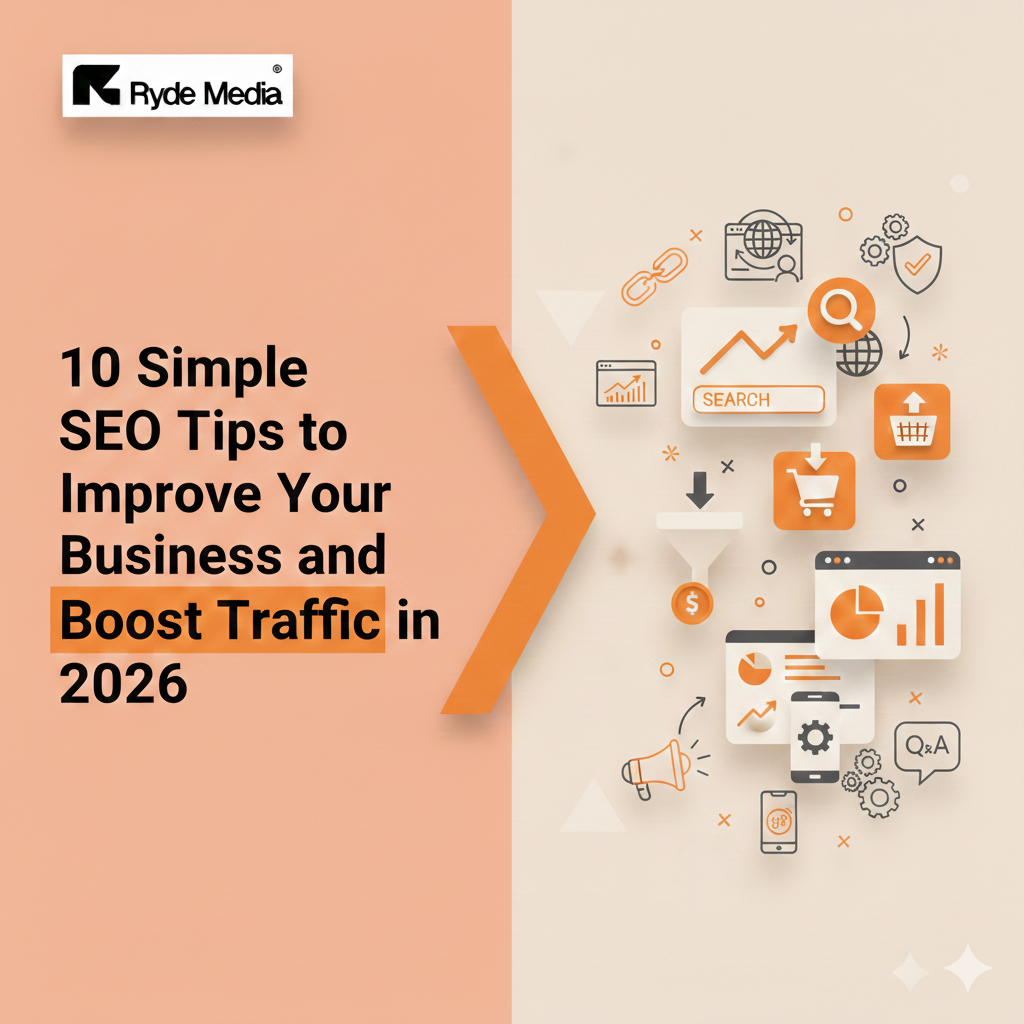
10 Simple SEO Tips to Improve Your Business and Boost Traffic in 2026
Running a small business means wearing multiple hats—managing operations, serving customers, handling finances, and somehow finding time to market your business online. When it comes to SEO, many small business owners feel overwhelmed by the technical jargon and constantly changing algorithms. The good news? You don’t need a massive budget or a team of experts to improve your search rankings and drive more traffic to your website.
At Ryde Media Inc, we’ve helped countless businesses implement simple, effective SEO strategies that deliver real results. These aren’t complicated tactics requiring advanced technical skills—they’re practical tips any business owner can start using today to improve their online visibility and attract more customers.
Let’s dive into 10 simple SEO tips for small business that will help you boost traffic, improve your rankings, and grow your business in 2026.

1. Start with Smart Keyword Research
Before you optimize anything, you need to know what your customers are actually searching for. Keyword research forms the foundation of every successful SEO strategy, yet many small businesses skip this crucial step.
Think about the questions your customers ask, the problems they’re trying to solve, and the exact phrases they might type into Google. Tools like Google Keyword Planner, Ubersuggest, and SEMrush can help you discover keywords with decent search volume and manageable competition.
Here’s a simple approach to keyword research for small businesses:
Focus on long-tail keywords (phrases with 3-5 words) rather than broad, competitive terms. Instead of targeting “accounting services,” go for “affordable accounting services for small businesses in Lagos.” These longer phrases have less competition and attract visitors with clearer intent.
Look for the sweet spot—keywords with reasonable search volume but lower competition. As a small business, you’ll find it easier to rank for these terms than trying to compete with established corporations for highly competitive keywords.
Create a simple spreadsheet documenting your target keywords, their search volume, and competition level. This becomes your roadmap for content creation and optimization.
2. Optimize Your Google Business Profile
For local businesses, your Google Business Profile (formerly Google My Business) is absolutely essential. When someone searches for businesses “near me” or in your specific location, Google prioritizes local results, making this one of the best SEO tips for small business.
Claim and verify your Google Business Profile if you haven’t already. Complete every section thoroughly—business name, address, phone number, hours, website, services, and description. Upload high-quality photos of your business, products, and team.
Encourage satisfied customers to leave reviews and respond to all reviews—both positive and negative. Google values businesses that actively engage with customers. Regular posts and updates signal that your business is active and relevant.
Ensure your business information is consistent across all online directories. Inconsistent NAP (Name, Address, Phone) information confuses search engines and can hurt your rankings.
3. Create Helpful, Valuable Content Consistently
Content remains king in 2026. But here’s the key—it must genuinely help your audience. Google’s helpful content update made it clear they prioritize content created for people, not search engines.
What are the most common questions you get from customers? What problems are they trying to solve? Create blog posts, guides, and resources that provide real answers. Don’t just scratch the surface—go deep. Comprehensive content tends to rank better than thin, superficial articles.
Aim for consistency rather than perfection. Publishing one quality blog post per week is better than publishing five mediocre posts one month and nothing for the next six months. Search engines reward consistent, fresh content.
Use clear headings (H2s and H3s) to organize your content. Break up text with bullet points, numbered lists, and short paragraphs. Make your content scannable—most people skim before they read deeply.
Include your target keywords naturally throughout your content, especially in headings and the first paragraph. But write for humans first, search engines second.
4. Optimize Every Page and Post
Creating great content is only half the battle—you need to optimize it properly. These simple SEO tips will help search engines understand and rank your content:
Title tags: Keep them under 60 characters and include your main keyword near the beginning. Make them compelling—this is what shows up in search results, so it needs to encourage clicks.
Meta descriptions: Write clear, benefit-focused descriptions under 155 characters. Include your keyword and a call-to-action. While meta descriptions don’t directly impact rankings, they significantly affect click-through rates.
URL structure: Keep URLs short, descriptive, and keyword-rich. “yoursite.com/seo-tips-small-business” is much better than “yoursite.com/p=12345.”
Image optimization: Compress images to improve page speed, and add descriptive alt text that includes relevant keywords. This helps both with accessibility and image search rankings.
Internal linking: Link to other relevant pages on your website. This helps search engines understand your site structure and keeps visitors engaged longer.
5. Make Page Speed a Priority
Site speed directly impacts both user experience and search rankings. Google has confirmed that page speed is a ranking factor, and in 2026, it matters more than ever. Users expect sites to load in under three seconds—anything longer and they’ll hit the back button.
Test your site speed using Google PageSpeed Insights or GTmetrix. These free tools identify specific issues slowing down your site and provide recommendations for improvement.
Simple ways to improve page speed include:
Compress images without sacrificing quality. Large image files are often the biggest culprits in slow load times. Enable browser caching so returning visitors load your site faster. Minimize HTTP requests by combining files where possible. Choose quality hosting—cheap hosting often means slow servers. Consider using a Content Delivery Network (CDN) to serve content faster globally.
If technical optimization feels overwhelming, consider bringing in a web developer for a one-time site speed audit and fixes. The investment pays dividends in improved rankings and user experience.
6. Ensure Your Site is Mobile-Friendly
More than 60% of searches now happen on mobile devices, and that percentage continues to grow. Google uses mobile-first indexing, meaning they primarily use the mobile version of your site for ranking and indexing.
Test your site on multiple devices—phones, tablets, different screen sizes. Can visitors easily navigate? Are buttons large enough to tap? Is text readable without zooming? Does everything work smoothly?
Use responsive design that automatically adapts to different screen sizes. Ensure forms are simple to complete on mobile. Make sure pop-ups don’t cover content or make navigation impossible.
This is one of the most important SEO tips for small business because a poor mobile experience doesn’t just hurt rankings—it drives potential customers away before they ever contact you.
7. Build Quality Backlinks Strategically
Backlinks—links from other websites to yours—remain one of the strongest ranking signals. They signal to Google that other sites consider your content valuable and trustworthy.
But here’s the key: quality matters far more than quantity. One link from a respected industry publication is worth more than dozens of links from low-quality directories.
How to improve SEO for small business through backlink building:
Create genuinely valuable content that others naturally want to link to—comprehensive guides, original research, useful tools, or unique insights. Reach out to local news sites, industry blogs, and relevant publications with story ideas or expert commentary. Guest post on reputable sites in your industry, providing value to their audience while earning a quality backlink.
Register your business in legitimate local and industry-specific directories. Join local business associations and chambers of commerce—many include member directories with backlinks. Build relationships with complementary businesses that might naturally link to your resources.
Avoid buying links or participating in link schemes. Google penalizes these practices, and the risk far outweighs any temporary benefit.
8. Leverage Customer Reviews and Testimonials
Reviews don’t just influence purchase decisions—they impact SEO. User-generated content signals trust and relevance to search engines. Positive reviews on Google, Facebook, and industry-specific platforms strengthen your local SEO and overall online presence.
Make it easy for happy customers to leave reviews. Send follow-up emails after purchases or completed services with direct links to your review profiles. Respond to all reviews promptly and professionally—positive ones to show appreciation, negative ones to demonstrate your commitment to customer satisfaction.
Feature testimonials prominently on your website. Consider using schema markup to help search engines understand and potentially display your ratings in search results. This can significantly improve your click-through rates.
Remember, reviews are ongoing. Make collecting and responding to reviews part of your regular business routine, not a one-time effort.
9. Optimize for Voice and Visual Search
The way people search is evolving. Voice search through smartphones and smart speakers is growing rapidly, and visual search through tools like Google Lens is becoming more common.
How to boost your SEO for these emerging search methods:
For voice search, focus on conversational, question-based keywords. People speak differently than they type. Optimize for phrases like “Where can I find affordable SEO services near me?” rather than just “SEO services.”
Create FAQ sections that directly answer common questions in natural language. Ensure your local information is accurate and complete—voice searches often have local intent.
For visual search, use high-quality images with descriptive filenames and detailed alt text. Include relevant keywords in image titles and captions. The more context you provide, the better search engines can understand and surface your images.
10. Track, Measure, and Adjust
Free SEO tips for small business don’t mean much if you’re not measuring what’s working. Google Analytics and Google Search Console provide invaluable insights into your website performance and search visibility—and they’re completely free.
Set up Google Analytics to track visitor behavior—where they come from, which pages they visit, how long they stay, and what actions they take. Google Search Console shows you which keywords you’re ranking for, your average position, click-through rates, and technical issues affecting your site.
Review this data monthly. Which pages get the most traffic? Which keywords drive the most visitors? Where do people drop off? Use these insights to refine your strategy—create more content around topics that resonate, improve pages with high traffic but low conversion, and fix technical issues promptly.
SEO for business growth requires ongoing attention and adjustment. What worked three months ago might need refinement today. Regular monitoring helps you stay ahead of changes and continuously improve.
Start Improving Your SEO Today
These simple SEO tips to improve your business aren’t complicated or expensive—they just require consistency and commitment. You don’t need to implement all ten strategies overnight. Start with the ones that make the most sense for your business, execute them well, and gradually expand your efforts.
The businesses that win with SEO aren’t necessarily those with the biggest budgets. They’re the ones who understand their customers, create genuine value, and consistently apply best practices over time. Affordable SEO for small business is absolutely achievable when you focus on the fundamentals.
At Ryde Media Inc, we help businesses implement effective SEO strategies that deliver real, measurable results. Whether you’re just starting your SEO journey or looking to take your existing efforts to the next level, we’re here to help you grow your online presence and drive the traffic your business deserves.
Ready to boost your website traffic and grow your business? Let’s make it happen together.