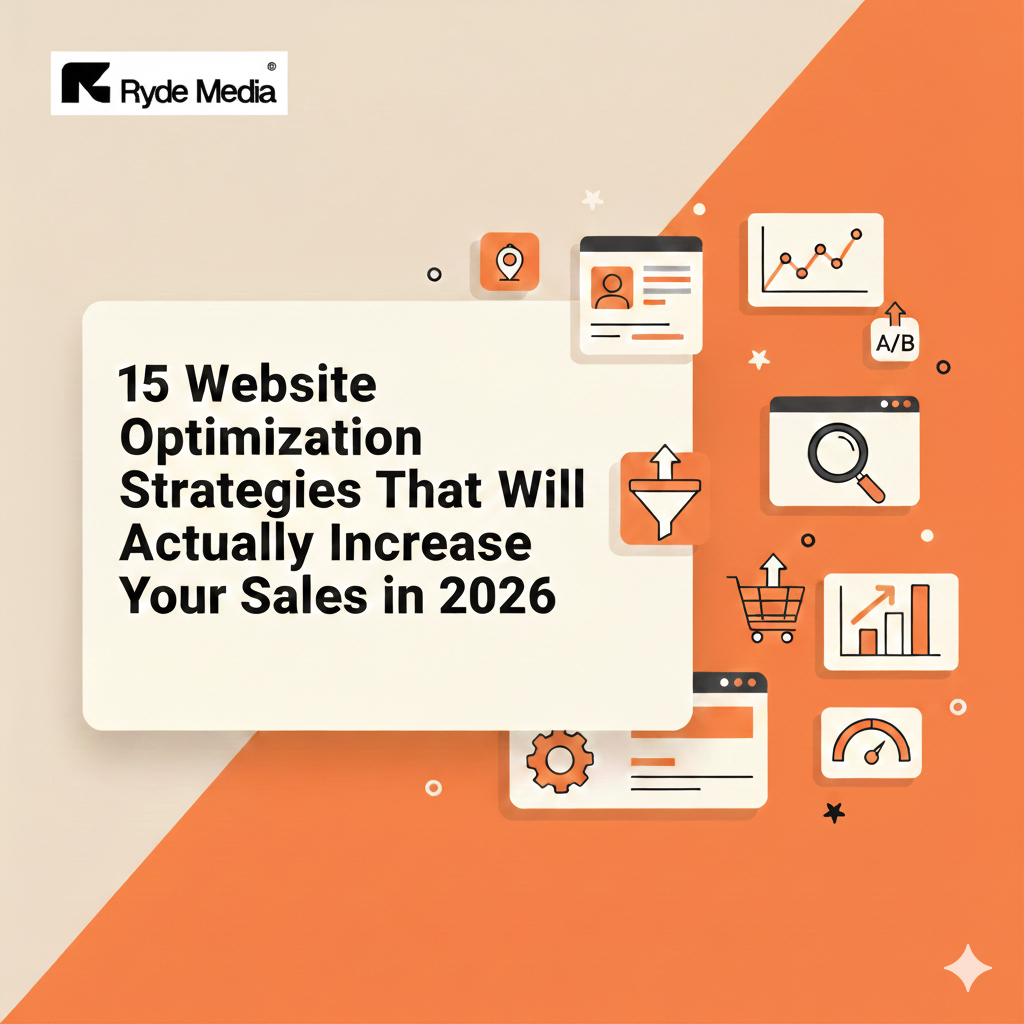
15 Website Optimization Strategies That Will Actually Increase Your Sales in 2026
Your website gets traffic. People visit, they browse, maybe they add items to cart—then they disappear. You’re investing in ads, creating content, driving visitors to your site, but the conversion rates tell a frustrating story.
Here’s the truth: traffic without optimization is just expensive window shopping. Your website isn’t just a digital brochure, it’s your most valuable salesperson, working 24/7.
At Ryde Media Inc, we’ve helped businesses across Nigeria and beyond transform underperforming websites into sales-generating machines through strategic optimization. The strategies we’re sharing aren’t theoretical, they’re proven approaches we use to help our clients turn traffic into consistent sales.
Whether you’re an e-commerce store, service provider, or B2B company, these 15 website optimization strategies will help you maximize every visitor and significantly increase your online sales.
What Is Website Optimization and Why Does It Matter?
Website optimization in digital marketing is the systematic process of improving your website to increase conversions and sales. It encompasses everything from technical performance and user experience to design and psychological triggers that influence buying decisions.
Why is website optimization important? Because small improvements compound dramatically. If your site converts 2% of visitors and you improve to 3%, you’ve increased sales by 50% without spending more on traffic. A site converting 1,000 monthly visitors at 2% generates 20 sales. Optimize to 4%, and you’re getting 40 sales from the same traffic.
The best website optimization for sales focuses on understanding user behavior, identifying where potential customers drop off, and removing obstacles between interest and purchase. Let’s explore how to increase website sales through proven strategies.
Strategy 1: Optimize Website Performance and Speed
Page speed directly impacts sales. Visitors expect sites to load in under three seconds—anything longer and they’re hitting the back button.
How to optimize website performance starts with measuring your current speed using Google PageSpeed Insights. Common issues include oversized images, excessive scripts, and poor hosting.
Compress images, minimize HTTP requests, enable browser caching, and use a Content Delivery Network (CDN). These technical improvements dramatically impact whether visitors stay long enough to buy.
Strategy 2: Create a Mobile-First Experience
Over 60% of web traffic comes from mobile devices, and that percentage is higher in Nigeria. If your website doesn’t work flawlessly on smartphones, you’re losing more than half your potential sales.
Mobile optimization means designing primarily for mobile users—larger buttons, simplified navigation, easy-to-read text, and streamlined checkout processes that work perfectly on small screens.
Test your website on multiple devices. Can visitors easily navigate? Are forms simple to complete? Does checkout work smoothly? If mobile users face friction, they’ll abandon your site for competitors.
Strategy 3: Clarify Your Value Proposition Immediately
Visitors decide within seconds whether your site offers what they need. Your value proposition must be crystal clear above the fold on your homepage and key landing pages.
State clearly what you do, who you serve, and what makes you different. Use specific language, not generic corporate speak. “We help Lagos businesses reduce shipping costs by 40%” beats “We provide innovative logistics solutions.”
Your headline should immediately answer: “Is this for me, and should I stay?”
Strategy 4: Simplify Navigation and Site Structure
Complex navigation confuses visitors and kills conversions. Your site structure should be intuitive, with clear paths to key pages.
Limit main navigation to 5-7 items. Use descriptive labels—”Services” beats “What We Do.” Make important pages accessible within three clicks from anywhere.
Include prominent search for larger sites and breadcrumb navigation so visitors always know where they are. The easier you make it for people to find what they want, the more likely they are to buy.
Strategy 5: Use Clear, Compelling Calls-to-Action
Every page should guide visitors toward a specific action. Your calls-to-action should be visually prominent, action-oriented, and specific.
“Get Started” is vague. “Start Your Free Trial” or “Get Your Custom Quote” tells visitors exactly what happens next. Use contrasting colors and place CTAs strategically throughout pages.
Test different CTA copy, colors, and placements. Small changes can produce significant conversion increases.
Strategy 6: Build Trust with Social Proof
People buy from businesses they trust. Social proof—customer testimonials, reviews, case studies, client logos, and trust seals—dramatically increases conversions.
Display testimonials prominently on key pages. Use specific testimonials with names and details. “This software increased our productivity by 35% in two months” beats “Great product!”
Show real numbers—customers served, successful projects completed. For e-commerce, display product reviews prominently. Sites with reviews convert 58% better than those without.
Strategy 7: Optimize Product and Service Pages
Your product pages must convince visitors they’ve found the solution. This requires compelling copy, quality images, clear benefits, and answers to common objections.
Focus on benefits, not just features. Explain how your product improves customers’ lives. Use high-quality images from multiple angles. Include videos demonstrating products in action when possible.
Address common questions directly on the page. Make pricing transparent. Ambiguity creates hesitation, and hesitation kills sales.
Strategy 8: Streamline Your Checkout Process
Cart abandonment rates average 70%. The culprit? Complicated checkout processes that create friction.
How to increase online sales through checkout optimization: minimize steps, allow guest checkout, display progress indicators, offer multiple payment options, show shipping costs early, and enable address autocomplete.
Remove unnecessary form fields. Display trust badges during checkout. Save cart contents for returning visitors. Every obstacle you remove increases completion rates.
Strategy 9: Implement Strategic A/B Testing
Stop guessing what works—test it. A/B testing compares two versions of a page element to see which performs better. Test headlines, CTA buttons, images, layouts, and copy.
Website optimization tools like Google Optimize make A/B testing accessible. Start with high-impact elements like main headlines or CTA copy. Run tests long enough to gather significant data.
Businesses seeing the biggest optimization gains consistently test, learn, and improve through ongoing experimentation.
Strategy 10: Personalize User Experiences
Generic experiences convert poorly. Personalization—showing different content based on user behavior or location—significantly increases conversions.
Basic personalization includes showing different content to first-time versus returning visitors, displaying location-specific information, or recommending products based on browsing history.
Even simple personalization like addressing returning visitors by name or showing relevant products based on past purchases can increase conversion rates by 10-15%.
Strategy 11: Optimize for Search Intent
Understanding why people visit helps you optimize for conversions. Someone searching “best accounting software Nigeria” is comparing options. Someone searching “QuickBooks pricing” is closer to purchase.
Create content addressing different search intents—informational content for early-stage researchers, comparison content for those evaluating options, and transactional content for those ready to buy.
This website optimization strategy ensures you capture and convert visitors at every stage of their journey.
Strategy 12: Use Exit-Intent Popups Strategically
When visitors are about to leave without converting, exit-intent popups offer one last chance to capture their interest. These detect when users are closing the tab and present a targeted offer.
Effective strategies include offering discounts to first-time visitors, promoting free shipping, capturing emails with valuable lead magnets, or highlighting guarantees that address objections.
Don’t overuse this tactic, but strategic implementation can recover 10-15% of abandoning visitors.
Strategy 13: Optimize Images and Visual Content
Humans process visual information 60,000 times faster than text. High-quality images, infographics, and videos significantly impact how visitors perceive your brand.
Use professional photography, especially for products. Show products in context. Include zoom functionality. Add video demonstrations, which can increase conversions by up to 80% on product pages.
Balance visual quality with performance—compress images so they look great without slowing your site.
Strategy 14: Create Urgency and Scarcity
Psychological triggers like urgency and scarcity motivate action. When people believe an opportunity is limited, they act immediately rather than “thinking about it.”
Ethical scarcity tactics include limited-time offers with countdown timers, low stock alerts (“Only 3 left in stock”), or exclusive offers for early action. Be genuine—false scarcity damages trust.
Combine urgency with clear value. “Save 20% if you order in the next 24 hours” works. “Limited time offer” without specifics doesn’t.
Strategy 15: Continuously Analyze and Improve
Website optimization isn’t a one-time project—it’s an ongoing commitment. Use website optimization tools to continuously monitor performance, understand user behavior, and identify opportunities.
Google Analytics shows where visitors come from, which pages they visit, and where they drop off. Heatmap tools like Hotjar reveal where users click and scroll. Conversion tracking shows which marketing efforts drive sales.
Review data regularly. Which pages have high exit rates? Where do users abandon checkout? Which traffic sources convert best? Let data guide your optimization priorities.
Essential Website Optimization Tools
The right tools make optimization manageable and data-driven:
Free tools: Google Analytics, Google Search Console, Google PageSpeed Insights, and Hotjar (limited free plan) provide robust insights.
Performance tools: GTmetrix and Pingdom analyze speed and identify issues.
A/B testing: Google Optimize (free), Optimizely, and VWO enable systematic testing.
Behavior tools: Hotjar and Crazy Egg show how users interact with your site.
Start with free tools to establish baselines. Invest in paid tools as your optimization efforts mature.
Start Optimizing Today
These 15 website optimization strategies will increase your sales—but only if you implement them. Start with the areas causing the most friction. If your site loads slowly, optimize performance first. If mobile visitors bounce immediately, prioritize mobile experience.
Online sales optimization is iterative. Make improvements, measure results, and refine based on what you learn. Small, consistent optimization efforts compound into significant revenue increases over time.
At Ryde Media Inc., we specialize in website optimization strategy that transforms underperforming sites into sales-generating assets. From technical performance to conversion-focused design and strategic testing, we help businesses maximize every visitor and dramatically increase online sales.
Ready to stop leaving money on the table? Let’s optimize your website for the sales growth you deserve.